Low cost techniques for contaminant detection in drinking water
2021-present
Access to clean water is something that is far from guaranteed in developing nations around the world. One reason for the lack of such access is deficiencies in detection of contaminants, primarily due to economic reasons in already resource-limited communities. The requirements for the status quo scale from expensive individual equipment to a fully equipped microbiological laboratory with a highly trained staff. In such a context, lower cost technologies, especially one that does not require skilled personnel, to perform the measurement of various parameters to quantify water quality would benefit entire communities in developing nations.
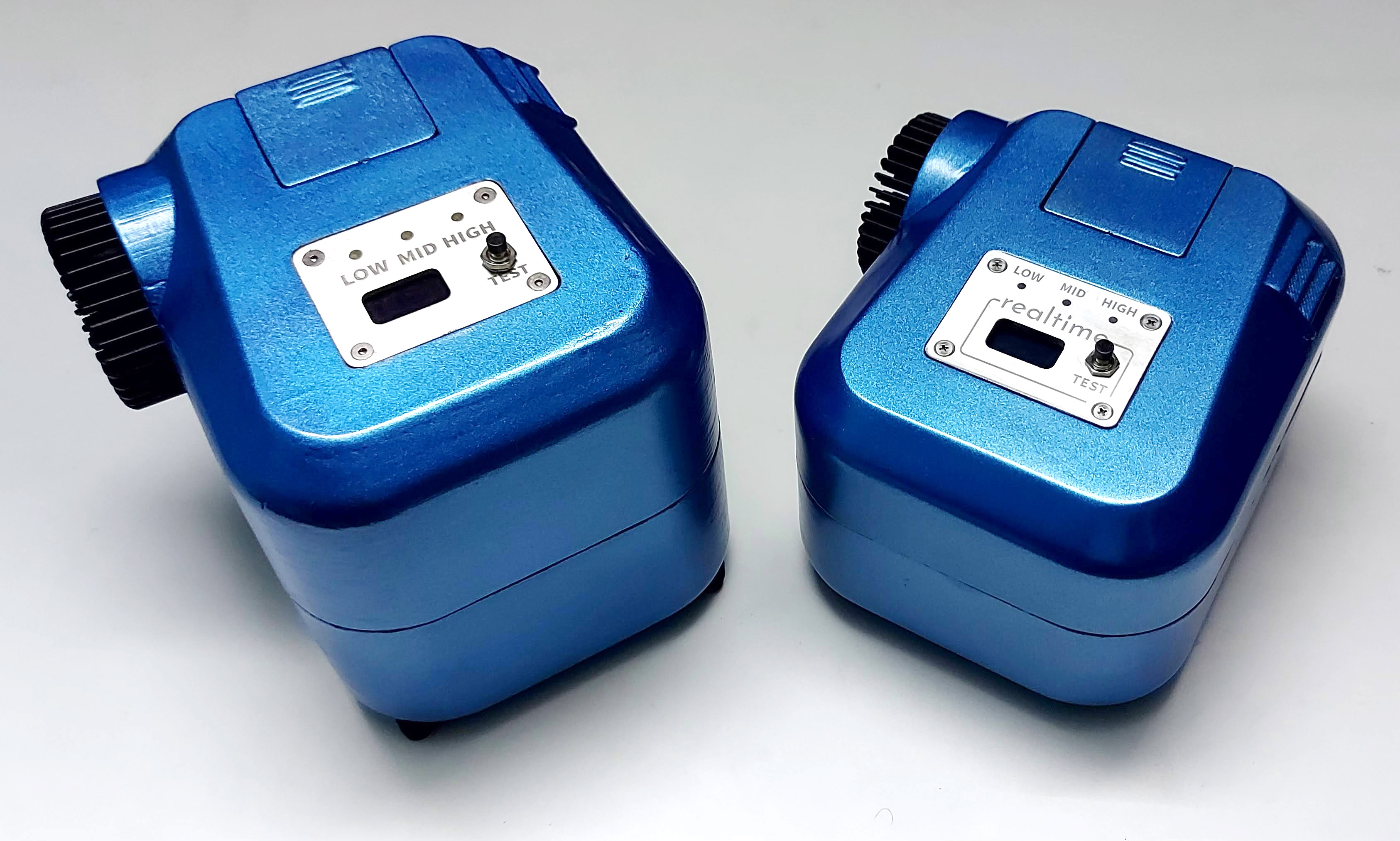
We use electro-optical methods to measure various parameters of a water sample to quantify its quality. While not a direct measurement, we present a device (realtimeWAS) to measure the fluorescence from a water sample which directly correlates with bacterial contamination in the water sample. We also show quantification of humic matter via fluorescence based on dilution experiments with quinine sulfate. Turbidity of the water sample is measured using scattering of infrared light. Similarly, the level of chlorine can be quantified with the help of an absorption meter in conjunction with commonly available DPD tablets, using transmission measurement of a given sample. Given that TDS (total dissolved solids) and conductance of water are closely related parameters, we can measure the conductivity of the water sample to quantify TDS. None of the above parameters require any reagents, nor do they require a high level of skill for operation.
Dense Particle Suspensions
2014-2018
Adviser: Eric Brown
Suspensions of hard particles show a number of interesting properties, including shear thickening which is when the viscosity of the fluid increases with the level of shear applied. These fluids have remarkable impact response. This particular property allows for some fun experiments, like being able to run on the surface of cornstarch suspensions in water, vibrating monsters, etc. What this also means is that we could potentially use shear thickening fluids to build flexible, self-healing, impact protection devices.
Turbulent Boundary Layers
2013-14
Adviser: Daniel R. Sabatino
When a fluid passes around and over an object, the velocity develops a gradient near the surface because of the no-slip condition that forces the velocity to be zero at the surface. This velocity gradient layer is called the boundary layer and can be laminar or turbulent. Laminar boundary layer is characterized by stream lines that are essentially parallel to the surface. Turbulent boundary layer consists of apparently random flow that mixes, and is often described as chaotic. Turbulent boundary layers have identifiable, elementary organized entities called coherent structures [1, 2]. These coherent structures are theorized to be responsible for creating and sustaining turbulence [2]. One such coherent structure is the hairpin vortex. In this project, we investigated how hairpin vortices interact with one another, and how further secondary hairpin vortices can re-generate from a primary hairpin.
Renewable Energy
2012
Adviser: Julia Nicodemus
When we hear solar energy, we typically associate it with solar photovoltaic (PV) technology. However, there also exists another renewable energy area in the solar domain – concentrated solar energy. In this project, we studied one of such systems. We performed thermodynamic and economic analysis of a two-step solar thermochemical cycle to generate syngas and hydrogen. Syngas can be used to create synthetic diesel fuel, and hydrogen gas can be used in fuel cells.
 Rijan Maharjan